
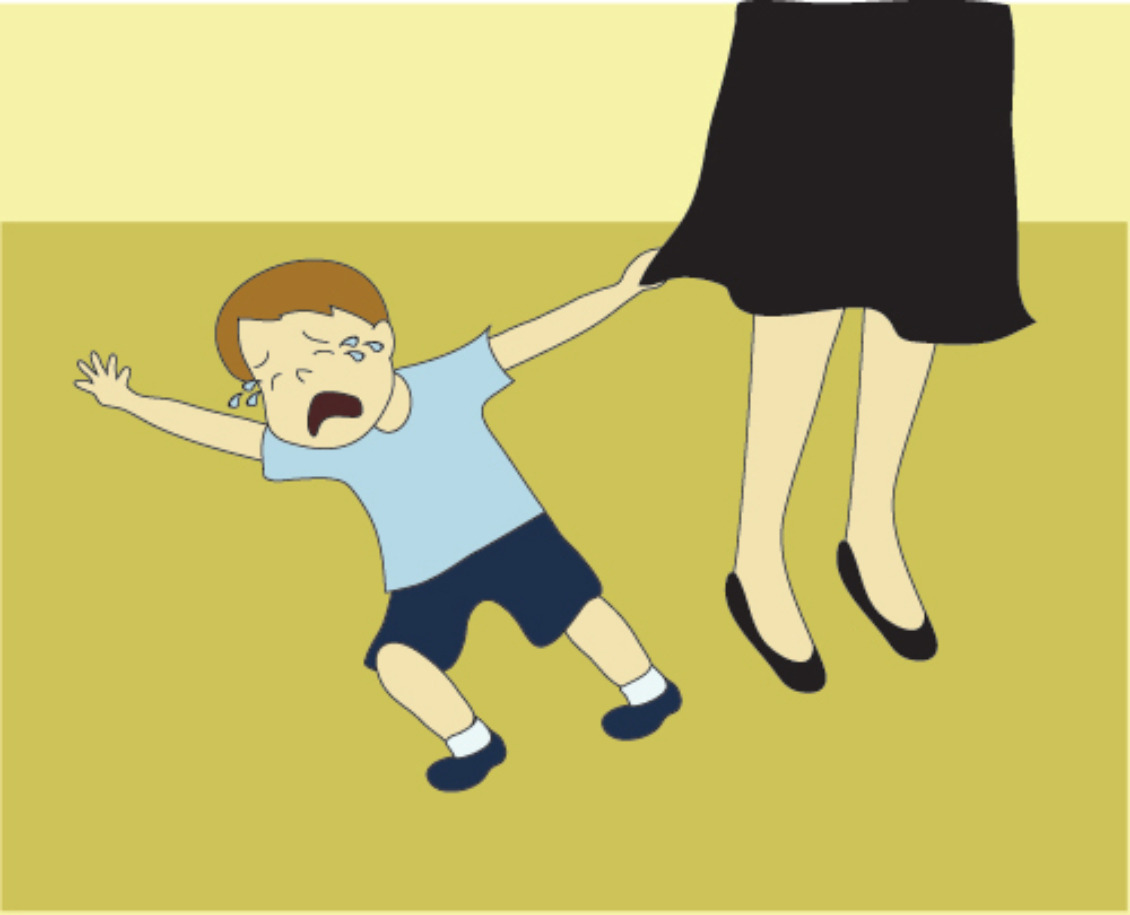
Fast-forward to now. I have a 2-year-old son, and my husband and I are trying to draw boundaries with him. His latest habit is to pull at my clothes. Over the summer and now, I’ve told him in a variety of different tones to stop this behavior, and he will only do so in the short term. The other day, we were out in public, and my son started to pull my pants down, and, much like my sister, giggled with glee when I told him to stop. I grabbed him, left the store, and got very upset with him in the car. He cried. My husband wants me to apologize for my outburst, but I don’t want to. Perhaps I didn’t act the best, but I’m not sorry for standing up for myself and my personal boundaries, especially when I’m raising a son in the #MeToo era. My son needs to understand that he cannot touch whomever he wants, whenever he wants and take joy in other’s discomfort. Being 2 years old doesn’t excuse his behavior. Is it wrong to have my son hurt a little bit over this? If I don’t do SOMETHING, I worry he’s going to turn out like my sister.
A: Thank you for writing. While your particular issue is quite specific, parents feeling triggered into remembering their own painful pasts by their children’s behavior is extraordinarily common. I have spoken to hundreds and hundreds of parents, and I have yet to meet a parent who doesn’t feel as though their buttons aren’t pushed at some point with their children. In some ways, you are fortunate: You know exactly why you had such an outsize reaction to your son. You know that you felt bullied by your sister, and your parents didn’t do enough to protect you (and maybe they still don’t).
But while you know this, there is a huge disconnect between feeling bullied by your child and jumping to some of the conclusions you reached. So, let’s unpack this a little.
[sc name=”Button Conflict to Cooperation Right”]
First, while we all want to be sensitive to unwanted touches and teaching our children about them, it is utterly inappropriate to bring #MeToo or your crossed boundaries into what your son did. Pulling on your clothes probably began as a practical way to get your attention: Parent’s eyes are really far up there and your pants are right in front of him. Because a 2-year-old is utterly impulsive, he grabbed your pants to get your attention; they are right there in his face. He didn’t plan it, he isn’t trying to assault you or disrespect your boundaries. Your pants were just there. The reason he keeps pulling them is because it works! He gets a reaction from you. As soon as you speak to him about not pulling, all that registers for him is, “My parent is looking at me!” His little brain is firing and wiring, and the little neural pathway says, “When I pull mom’s pants, she pays attention to me.” Does it matter that this attention is negative? No, not really. For a young child, attention is attention . . . that’s how basic the need is. So, when you say, “Being 2 years old doesn’t excuse his behavior,” you are incorrect. It completely explains and excuses his behavior. You are placing blame and maturity on his shoulders that is simply counterfactual and worse, it is unkind and uncharitable. This isn’t about apologizing to him or not; this is about assigning blame to the wrong person.
Do I think you are a bad person or a sub-par parent? No. That you are doubling down in blaming your son for your reactions shows me how much pain you are in, and that your past is very much with you, right here and right now. Feeling victimized by your 2-year-old means you have some emotional work to do, and guess what? Join the parenting club. All of us are facing some uncomfortable truths and stories, but passing on our neuroses to our children is not the way forward here.
If I sound like I am being tough on you, it’s because I need you to see how you have played the victim role in your life. Your sister has victimized you, your parents have turned their backs on you, and now you are treating your 2-year-old as if he is a latent abuser, also victimizing you. You have the power to stop this, to put your past into context, and to move toward understanding that your son is simply a small boy who wanted his mother’s attention. No more, no less.
I strongly recommend that you get yourself back into therapy. I see therapy as not a “one and done” kind of thing. I see therapy as something that people can go in and out of, as needed. And as a new mother, your son is provoking feelings in you that need to be unpacked. There is no shame in this, and it isn’t as though therapy failed the first time around, but understanding your pain as a sister and daughter is quite different from understanding it as a mother.
As for your son, as soon as he pulls on your pants, either drop directly to eye level or pick him up and bring him to yours. As he and his language matures, he will be able to verbalize his needs. But this is years off, so you need more tools in your toolbox, stat. I suggest parenting classes (like PEP, if you are in the D.C. area) so that you can see how typical his behavior is, and find some solace in this fact.
Good luck.
Find this over on The Washington Post.
Looking for more parenting support? Click here.